
From the Holy Land to Your Living Room: How IPTV Keeps Christian Travelers and Sports Fans Connected
If you have ever stood on the Mount of Olives, sailed the Greek Isles on a faith-based cruise, or served on a mission trip in a remote region, you know the feeling: the journey feeds your soul, but the hotel television rarely feeds your love of the game. Meanwhile, back home, your small group is gathering on Sunday afternoon to watch the big match, and you are squinting at a buffering stream on a phone with one bar of signal. Whether you are a tour traveler, an expat, a missionary family, or simply a believer who enjoys fellowship around live sports, the way you watch television has quietly become one of the biggest practical puzzles of a modern, mobile life.
That is exactly where IPTV comes in. Internet Protocol Television is not a gadget or a gimmick — it is a completely different way of receiving television, one that travels with you, costs far less than a traditional cable package, and is built around the channels people actually watch. For families who invest their travel budget in pilgrimages, biblical tours, and short-term mission work, IPTV is the quiet upgrade that keeps everyone connected without draining the funds set aside for the next journey.
In this guide, we will look at how IPTV works, why it fits naturally into the rhythm of a faith-centered, travel-friendly household, which sports channels matter most across the United States and Latin America, how to set it up in minutes, and how to tell a legitimate provider from a risky one.
What Is IPTV and How Does It Transform Live TV and Sports?
Traditional television arrives through satellite dishes, coaxial cables, or antennas. IPTV delivers the same live channels and on-demand libraries through your internet connection instead. Your television, phone, tablet, laptop, or streaming stick becomes the receiver, and the content travels over the same connection that already powers your Wi-Fi.
The practical consequences are significant, especially for people who move around a lot:
- Location independence. Your subscription works wherever you have decent internet — a hotel in Jerusalem, a guesthouse in Lisbon, a mission base in Kenya, or your own living room.
- No installation appointment. There is no dish, no technician, and no two-year contract locking you into a price you will regret.
- Far more channels for far less money. Modern IPTV platforms carry thousands of live channels and tens of thousands of on-demand titles, often at a fraction of a traditional cable bill.
- Real sports coverage. Instead of hunting for a single channel, you get the full lineup: football, basketball, American football, baseball, motorsport, boxing, MMA, and more.
For sports fans, the difference is dramatic. A cable package might give you one or two of the channels showing a major match. A well-built IPTV service gives you the whole buffet — and that matters enormously when the Champions League, the Premier League, and the NFL season all land in the same weekend.
Faith, Fellowship, and the Beautiful Game: Why IPTV Fits a Christian Household
There is a quiet connection between travel, faith, and sport that rarely gets named. A pilgrimage is a shared journey with a shared destination. A match watched with friends is the same thing in miniature: people gathered around a common goal, celebrating together, groaning together, and building community in the process. For many families, Sunday afternoon football and Wednesday night small group occupy the same emotional space — they are rituals of belonging.
IPTV supports that rhythm in a few concrete ways:
1. It travels with you
Living Passages travelers often return home with dozens of photographs and a lighter wallet. What they do not want is to come home to a cable bill they paid for two weeks while sitting in a hotel in Athens. IPTV is portable, so the subscription works while you are away and while you are home. If you take a best IPTV service with multi-device support, you can watch a game on a tablet in an airport lounge and pick it up on the living room screen when you land.
2. It is a family budget decision, not just an entertainment one
Families who prioritize travel — whether that is a Holy Land tour, a Christian cruise, or a mission trip to Central America — tend to be intentional about money. Cutting a bloated cable package in favor of a lean streaming setup frees up real dollars. For many households, the savings from a single year of cable is a meaningful contribution toward the next trip.
3. It keeps the global church connected
Missionaries, expat families, and students studying abroad often want more than entertainment. They want the news, worship broadcasts, and yes, the football from home. An IPTV lineup with strong international coverage lets a family serving in Brazil keep up with the Brasileirão, or a family serving in Portugal follow the Liga Portugal table without hunting for a pirated stream at midnight.
4. It makes hosting easier
Super Bowl party after the service? A Champions League final watch-night in the fellowship hall? A multi-device IPTV plan means the game can run on the main screen while someone else keeps an eye on a second match in the kitchen. If you are curious how that setup looks in practice, you can explore the platform and channel lineup directly at rasfox.com.
Watching Sports on the Road: A Practical Guide for Christian Travelers
Anyone who has traveled with a group knows the drill. You arrive at the hotel tired, you turn on the television, and you find forty channels in a language you do not speak, no sports, and a remote with buttons that make no sense. Hotel Wi-Fi is often barely strong enough to send an email, let alone stream a match.
A few habits make IPTV work beautifully on the road:
- Download your streaming app before you leave. Installing it on the airport Wi-Fi is far easier than fighting with a locked hotel network.
- Test the connection as soon as you check in. Run a quick speed test. Anything above roughly 10–15 Mbps is comfortable for HD; 25 Mbps or more handles 4K smoothly.
- Carry a travel router or use your phone as a hotspot. This gives you a stable, familiar network in an unfamiliar place.
- Use your subscription on a tablet or laptop. Hotel televisions often block external inputs, but your own device never does.
This matters most for the travel moments that genuinely matter. A father serving on a short-term mission trip in Guatemala who wants to catch his son's college football game. A couple on a Christian cruise who want to see the second half of a Champions League match before dinner. A group of pilgrims in Rome during a major tournament. IPTV turns "I hope I can find it somewhere" into "it is already on my screen."
The IPTV Landscape: Sports-First Coverage for the U.S. and Latin America
Not all IPTV providers are built alike. Some are general entertainment platforms that treat sports as an afterthought. Others — and this is the category worth your attention — are built around live sport first, everything else second.
One of the most interesting stories in this space comes from South America. Radio Malena 89.1 FM, broadcasting from Buenos Aires at Venezuela 370, spent years as a beloved voice of tango and Argentine cultural tradition. Today, that same heritage of connecting communities through sound has evolved into an IPTV platform built with a total focus on sports channels and live sports events, serving Portuguese- and Spanish-speaking audiences around the world.
That sports-first DNA shows up in the channel lineup, which is adapted to the region you care about most:
- Brazil: Globo, SporTV, Premiere, ESPN Brasil, BandSports, Combate, TNT Sports BR
- Portugal: Sport TV 1–6, Eleven Sports, Benfica TV, Porto Canal, DAZN Portugal, Eurosport
- Argentina & Latin America: TyC Sports, ESPN Premium, TNT Sports Argentina, Fox Sports, DirecTV Sports
- Africa: SuperSport, Sport TV Africa, ESPN Africa
- Worldwide / U.S. audience: ESPN, DAZN, Fox Sports, beIN Sports, Sky Sports, Eurosport
The competitions covered read like a sports fan's wish list: the Brasileirão, Copa Libertadores, the Champions League, Liga Portugal, the Argentine league, La Liga, the Premier League, Formula 1, and UFC — plus American football, basketball, and baseball seasons for viewers in the United States.
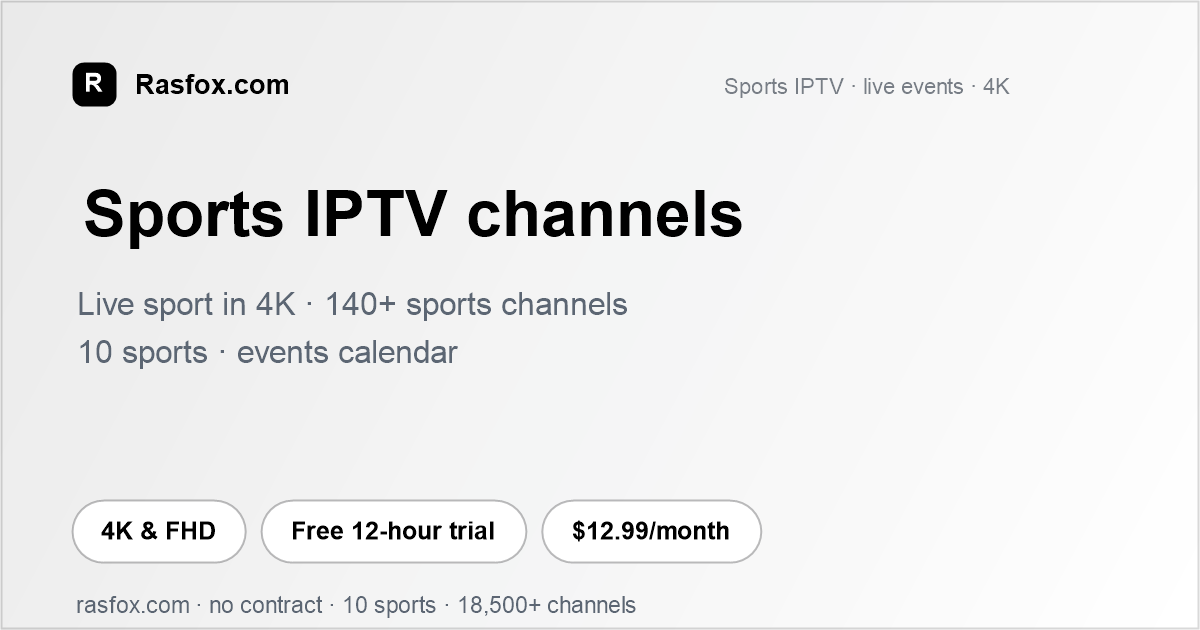
For English-speaking families in North America, this regional flexibility is the real advantage. You can keep your domestic sports intact while also gaining access to international football that American cable packages simply do not carry at a reasonable price. If you want to see the full lineup in your region, the fastest route is a 24-hour free trial — no contract, no commitment, just a chance to test it on your own internet connection before deciding.
What you actually get for the money
- 12,000+ live channels across sports, news, entertainment, and international programming
- 40,000+ on-demand titles in 4K at 50FPS — sharp, fluid motion for fast-paced sports
- Two simultaneous screens, ideal for a household where not everyone agrees on the game
- Smooth, buffer-free playback on a stable connection — no freezing mid-penalty
- No contract, no installation, no equipment rental fees
- Support in Portuguese and Spanish, with English assistance for North American customers
Hardware and Setup: What You Actually Need
One of the most common misconceptions about IPTV is that it requires technical skill. In practice, setup is closer to installing a phone app than configuring a satellite dish. Here is what a typical household needs:
The essentials
- A stable internet connection. 15 Mbps is a comfortable baseline for HD; 25–50 Mbps is ideal for 4K streaming or multiple simultaneous screens.
- A device. A smart TV with a built-in app store, an Amazon Fire Stick, an Android TV box, an Apple TV, a smartphone, a tablet, or a laptop.
- Your subscription credentials — a login or playlist, provided after signup.
Recommended upgrades for sports viewers
- Ethernet over Wi-Fi where possible. Wired connections eliminate nearly all buffering in busy households.
- A decent router. If your router is more than five years old, it is probably the weakest link in your streaming chain.
- A second screen. A tablet on the kitchen counter means nobody misses the final minutes of the match.
Setup in four steps
- Choose your device and install the IPTV application from its official app store.
- Enter the credentials provided with your subscription.
- Allow the channel list and EPG (electronic program guide) to load — this can take a few minutes the first time.
- Test a live sports channel during peak hours to confirm your connection is strong enough.
If you want a walkthrough tailored to your specific device, the support team can be reached directly through RasFox.com, where you can also compare plans before committing.
Legal vs. Illegal IPTV: How to Choose Safely and Wisely
This is the section most articles avoid, and it is the one you should read most carefully. The IPTV market contains two very different worlds, and the difference is not about technology — it is about licensing and legitimacy.
Licensed, legitimate IPTV services
A legitimate provider operates with proper distribution agreements, transparent pricing, published terms of service, real customer support, and a clear business identity. You know who you are paying, you can reach them if something breaks, and your payment is processed through normal channels. Pricing is realistic rather than suspiciously cheap, because licensing content costs money.
Unlicensed "grey market" services
These are the services that flood social media with too-good-to-be-true offers, take payment exclusively through untraceable methods, and disappear overnight. The risks are practical, not theoretical:
- No recourse. When the service vanishes, your money vanishes with it.
- Malware risk. Unofficial apps and sideloaded APKs are a common delivery vehicle for malicious software.
- Unstable quality. Servers overloaded with too many users produce exactly the buffering that made you leave cable in the first place.
- Legal exposure. In many countries, knowingly subscribing to an unlicensed service can carry legal consequences, and enforcement has increased significantly in recent years.
The responsible approach for any household — and especially for families who value integrity and stewardship — is to choose a provider with transparent terms, responsive support, and a legitimate business footprint. A published free trial, real customer service in your language, and a clear refund policy are all good signals. RasFox.com is built around exactly that model: a documented 24-hour trial so you can evaluate the service honestly before paying a cent, no long-term contract, and support staff who actually answer.
If you are unsure whether a provider is legitimate, ask three questions: Can I test it before paying? Can I reach a human being in my language? Is there a written terms-of-service page with a real company identity? If the answer to any of those is no, keep looking.
Frequently Asked Questions
Is IPTV better than cable for watching live sports?
For most households, yes. IPTV typically delivers far more sports channels for a much lower monthly cost, requires no installation or long-term contract, and works on the devices you already own. The main requirement is a stable internet connection of at least 15 Mbps.
Can I use IPTV while traveling or on a mission trip abroad?
Yes, provided you have a reasonable internet connection and your provider supports access from multiple locations. A travel router or mobile hotspot makes the experience far more reliable in hotels and guesthouses.
How much internet speed do I need?
Around 10–15 Mbps is enough for smooth HD streaming on one device. For 4K content or two simultaneous screens, aim for 25–50 Mbps. A wired Ethernet connection is strongly recommended for the main television.
Will IPTV work on my existing smart TV or Fire Stick?
In most cases, yes. Popular IPTV applications are available for Android TV, Fire TV, Apple TV, iOS, Android, and most modern smart TV platforms. Older televisions can be upgraded with an inexpensive streaming stick.
What does a good IPTV service include?
A quality provider offers thousands of live channels, a large on-demand library, 4K streaming at 50FPS for sports, multiple simultaneous screens, no long-term contract, and responsive customer support. RasFox offers 12,000+ channels, 40,000+ VOD titles, two screens, and a 24-hour free trial at https://rasfox.com/.
Final Thoughts: Faith, Family, and the Freedom to Watch Anywhere
The best travel experiences do not ask you to give up the things you love — they give you new ways to enjoy them. For households shaped by faith, fellowship, and a genuine love of the journey, IPTV solves a very modern problem: how to stay connected to home, to community, and to the game, without paying for a cable subscription you barely use or fighting with a hotel remote in a foreign city.
Start with a free trial. Test it on a Sunday afternoon when three matches overlap and the whole family wants something different. If it holds up under that pressure — smooth, sharp, buffer-free, on two screens at once — you have your answer.
Explore the full channel lineup, compare plans, and begin your free 24-hour trial at the best IPTV service for sports fans and travelers. Safe travels, and enjoy the match.